Goal orientation for maximum motivation: approach versus avoidance

Consciously framing goals in 'approach' terms (growth mindset) motivates teams better than 'avoidant' framed goals, during challenging times. But, this may be flipped on its head when writing proposals for executive teams. I first posted this article internally at Automattic in Oct 2022.
I was a public library manager in North Yorkshire, in the UK, during what the government at the time called ‘austerity’. This saw deep cuts to public services, resulting in the restructuring of the service, involving large-scale redundancies. The executive teams communicated the bad news and the urgency. That was their role. And thanks to that clarity, nobody was in any doubt about the gravity of the situation and that those of us remaining, needed to dig in to help the service survive and thrive.
Preventing teams descending into pessimism or avoidant behaviours (or worse, sabotage) was my job; so I framed the motivation for my team in terms of opportunity. We were going to train volunteers; develop expertise in supporting voluntary teams; negotiate with funders; broaden our skill set; maintain and even support volunteers to grow standards and service provision for the public; play our part in helping our local communities transition. This turned a depressing situation into something in which my team could (and did) engage with determination and spirit.
Leads at Automattic (where I'm currently working in leadership development), like at many companies worldwide at a time of economic and political challenge, are engaged in a drive for impact, performance, and efficiency. We’re making sure we all are looking at our costs, thinking about frugality, thinking about doing more with smaller teams; working on the things that are generating the most value for our customers and the most value for the company.
In 'anti-fragile' times, we have to consider carefully what goals we set our teams, and how best we can frame them to continue driving motivation.
I’d like to propose an aspect we can consider when we’re setting goals with our teams in a time of challenge. That’s the orientation of the goal; and to consider it with respect to what will motivate your audience.
- Objectives such as “increase manager effectiveness”; “increase engagement scores” or even “drive revenue” are positive or approach goals. They emphasise the benefits.
- Objectives such as “reduce attrition” or “reduce costs” are loss-reducing or avoidant goals.
There’s no objective value judgement here, as each framing has its place in its context.
When the audience is the individual contributors
Urgency sometimes compels us to set avoidance goals with individual contributors as a short term measure. That’s part of reality. But to make sure employees come along with us, remain engaged and feel personal commitment to their work through the longer term, it’s good practice to reframe these as approach goals – wherever it makes sense to do so.

Andrew Elliot and Ken Sheldon called their work on this approach the “self-concordance model” – referring to goals which are aligned with an individual’s core values, resulting in higher ownership, effort and engagement.
This idea of goal orientation is also closely related to concepts of growth mindset, as well as the embedded notions of performance vs mastery. I saw the growth mindset in play at Automattic. In Happiness (technical customer success/support) for instance, the Happiness Engineer plays a direct part in the customer’s journey towards scaling, success and growth, actively learning as they go. This is part of a growth mindset, and also speaks to a key intrinsic motivation for doing their job, for many HEs, which is helping and supporting others.
In the growth mindset, the individual seeks mastery (challenge, seeking competence, hard work and understanding that effort has rewards, self motivation) rather than performance (demonstrating achievements, staying safe, avoiding challenge, fear of appearing incompetent). (It’s true that the word ‘performance’ tends to be understood in a different way in a management context, and the growth mindset language originates from education which is where these notions come from originally).
What about a project proposal for an executive team audience?
I’ve been suggesting here that goals addressed to teams and individual contributors are most motivational and engaging if they’re expressed in positive, or approach-oriented terms. However, if you’re at the stage of drafting a project and the goal of the project needs stakeholder buy-in, it may be that a different framing will help.
It is likely that the ‘real’ goal of a project or process will have both approach and avoidant aspects. Just because the approach objective is motivational to teams and individual contributors, doesn’t mean it will be so to executive teams. Often, if there is a buy-in gap with stakeholders at the moment of project proposal, the disconnect is in the orientation of the objective.
While overall, the underlying goals are the same for everyone (we are working together towards the same outcome), senior leadership and executive teams may have different immediate priorities than direct contributor teams do. An avoidant orientation may speak more strongly to these priorities than the approach orientation. This can be helpful to bear in mind when pitching projects or strategic directions.
Encouraging a challenge-engaging disposition in the context of antifragile and pre-failure
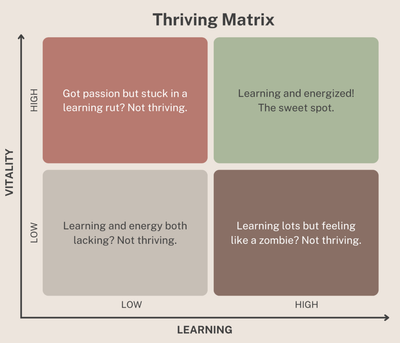
I think this is key to how we think about antifragile. I found a graphic that for me, ties a few things together helpfully in navigating motivation goals for individual contributors in antifragile times: it illustrates, in a context of challenge or difficulty (which is framed here as “pre-failure”) the connection between mindset and goal orientation.

Pre-failure and anti-fragile are both interesting vocabulary choices that share their oppositional (avoidant) framing: “against” the negative. But built into both is the opportunity to tackle them with an approach, growth and mastery orientation. We want our teams to end up in the right hand red box (challenge-engaging).
Antifragility is beyond resilience or robustness. The resilient resists shocks and stays the same; the antifragile gets better. - https://fs.blog/antifragile-a-definition/
Different framings of the same goal
As an example of how different framings are appropriate for the same goal, imagine a scenario where we are changing the work a team carries out. For instance, a cost saving goal as expressed at the proposal stage, with the audience of high level stakeholders, might be worded as “halting low priority work” and focused around the savings this represents. When expressed to the team, though, it might be re-emphasised in terms of “refocusing the team towards higher priority work” and around the learning and other opportunities this represents.
I’m not advocating hiding the gravity or urgency of a “pre-failure” landscape that many tech firms find themselves in, at a time of economic challenge. Coming from a growth mindset (as Automattic does, with consistency) essentially means the challenge becomes a welcome one to engage with, for individual contributor teams, once it’s framed in terms of approaching mastery.
So looking back at my library service restructure experience through this lens, the key strategic goals for the libraries executive team were, naturally, framed as avoidant:
Achieve budget savings of £1.4m
Retain current service provision
Minimise the impact on communities
North Yorkshire County Council
With my team, our goals were the same but reframed as approach and growth oriented:
Work with a reduced team meaning that we each have a real individual impact on shaping the future of the service;
Train and support volunteers to maintain and grow standards and service provision;
Help our local communities transition and use or discover what the library offers, including the opportunity volunteering represents
And including personal development goals for the team:
Develop expertise in supporting voluntary teams and training volunteers; learn to apply for funding and negotiate with local stakeholders
That was the secret sauce that got my library team through the restructure. By playing my role to motivate my team in the most strategic way, I could respond to both the needs of the organisation and that of my team with no cognitive dissonance necessary. We were able to navigate the hard times with success, and engage with that challenge in a positive way.
Conclusion
When you’re in a position of setting goals with your team, consider how you can frame our desired outcomes in a way that is likely to motivate, inspire and encourage growth in your team members; that foregrounds effort, opportunity, innovation, collaboration and personal progress.
When you’re pitching a project to leadership stakeholders, consider whether your framing of your proposed outcomes may be subtly different, perhaps in terms of loss avoidance, to speak to their priorities more clearly.
You may choose to do a little of both.
Further reading:
- LifeLabs session: How to Gain Buy-in for L&D
- A. Elliot & K. Sheldon: Avoidance achievement motivation: a personal goals analysis.
- Kate Leto: Goals Gone off the Rails? Here are 3 Ways to Get Back on Track
- Anthony Grant & Gordon Spence: Using Coaching and Positive Psychology to Promote a Flourishing Workforce: A Model of Goal-Striving and Mental Health
- Carol Dweck: How Companies Can Profit from a “Growth Mindset” Goal orientation for maximum motivation: approach versus avoidance
- Dr. Mark Orpen-Lyall, Goal-setting: (NOT) for dummies